A few years back a tree was discovered in Sweden that is the oldest in the world. According to an article in National Geographic a 13 foot tall tree was discovered in the Dalarna Province which was carbon dated to have root systems over 9550 years old.
According to one of the researchers "Trees much older than 9,550 years would be impossible in Sweden, because
ice sheets covered the country until the end of the last Ice Age around
11,000 years ago."
I think it is amazing that not only is there something living on this planet that is that old but also the fact that we have figured out how to measure how long living things like trees have been around through carbon dating.
Sunday, April 28, 2013

Friday, April 26, 2013
Micronations
Ever hear of a "micronation" before? My guess is probably not.
A micronation is an entity that claims to be an independent state even without international recognition. One of the most famous micronations is the Principality of Sealand. They were "founded" in the 1960s on an old British Sea fort.
The following is a great video showing a micronation in the Nevada desert.
A micronation is an entity that claims to be an independent state even without international recognition. One of the most famous micronations is the Principality of Sealand. They were "founded" in the 1960s on an old British Sea fort.
The following is a great video showing a micronation in the Nevada desert.
Thursday, April 18, 2013
The power of social media
The recent bombings in Boston have captivated every American since Monday. With the recent release of the two suspect's photos, more information is making it forward. An article published less than an hour ago (it's 12:23 Central) shows an even clearer photo.
How much more powerful will social media become?
How much more powerful will social media become?
Sunday, April 14, 2013
Little holes on coffee bags
If you've ever noticed the little holes on your bag of gourmet coffee you may have wondered what they are exactly used for in the first place. Well, fear not any more.
According to About:
Freshly roasted coffee beans give off a great deal of carbon dioxide, for several hours after roasting. To prevent this "off-gassing" from bursting their bags, coffee roasters used to hold coffee for up to 24 hours before packaging. This meant that your coffee was already a day old before it even left the supplier.
By using bags with one-way air valves, coffee can be packed immediately without off-gassing worries. A bag with valves tells you that your supplier is interested in providing a good product, and that your coffee is as fresh as possible.

According to About:
Freshly roasted coffee beans give off a great deal of carbon dioxide, for several hours after roasting. To prevent this "off-gassing" from bursting their bags, coffee roasters used to hold coffee for up to 24 hours before packaging. This meant that your coffee was already a day old before it even left the supplier.
By using bags with one-way air valves, coffee can be packed immediately without off-gassing worries. A bag with valves tells you that your supplier is interested in providing a good product, and that your coffee is as fresh as possible.

Tuesday, April 9, 2013
Energy consumption through email
Believe it or not, the e-mail service you use has an impact on the amount of energy consumed. A study found on OPOWER's blog revealed that "the aggregate difference in annual electricity use between 1 million Yahoo households and 1 million Gmail households is…equal to the entire annual electricity consumption of Barbados, a reasonably well-off country of 287,000 people."
What this translates into is an estimated $110 per year difference in electric bills. The website asks a few questions that pry at the reasoning behind the increased consumption of Yahoo users.

By contrast, Yahoo users are more likely to be in relationships and
have children. Additionally, Hunch found that Gmail users are more
likely to be active travelers (having journeyed to 5 or more countries), and so might be away from home more often."
Overall, this study is pretty interesting and gets me to thinking about what other types of things we as American's do to consume energy without necessarily realizing it.
What this translates into is an estimated $110 per year difference in electric bills. The website asks a few questions that pry at the reasoning behind the increased consumption of Yahoo users.

Basically, what the study concluded was that Gmail users and Yahoo users have fundamentally different lifestyles. The site claimed that:
"Hunch.com and Experian have found that Gmailers are more likely to be younger, single people. Credit Karma found the average Gmailer’s age to be 34, while the average Yahoo user
clocked in at age 38. Being young and single means going out more; less
time at home – and fewer occupants – means less electricity usage.
Overall, this study is pretty interesting and gets me to thinking about what other types of things we as American's do to consume energy without necessarily realizing it.
Monday, April 8, 2013
War on Drugs
Back in 2010, I took a class in which we were required to write a massive research paper. I decided to write my paper on why the War on Drugs should be ended. Since that paper was written, various steps have been taken to defy the federal government's steps taken to continue the War. For example, if you haven't been living under a rock for the past six months, many of you may have heard of the recent legislation if Washington and Colorado that has essentially legalized marijuana use.
Besides these baby steps taken to inch the repeal of the War closer along, more and more publications and articles are coming out which give voice to the majority of American's who want the war to end in its entirety.
The ACLU recently came out with this chart regarding the drug war. Take a look for yourself and decide if you think it's as shocking as I do.

Besides these baby steps taken to inch the repeal of the War closer along, more and more publications and articles are coming out which give voice to the majority of American's who want the war to end in its entirety.
The ACLU recently came out with this chart regarding the drug war. Take a look for yourself and decide if you think it's as shocking as I do.

Thursday, April 4, 2013
Pinhole camera
Recently I saw an oatmeal box in a friends room and for some odd reason it reminded me of a time when I was a kid and I made a pinhole camera out of an old oatmeal box. Essentially, what the camera does is reproduce what your eye does. A small portion of light is flooded into a pinhole in a completely dark container i.e. an oatmeal box and the image is then developed on photo paper. It sounds complicted but if I could make it when I was 12, anybody can.
Below are two resoruces to help.
This first is a link to a SDSU physics page which has really, REALLY detailed information. Pay close attention to the film development portion.
Next is a quick overview video that shows how to make it and it serves as an excellent supplement to the lengthy instructions (and is actually far less complicated)
.
Below are two resoruces to help.
This first is a link to a SDSU physics page which has really, REALLY detailed information. Pay close attention to the film development portion.
Next is a quick overview video that shows how to make it and it serves as an excellent supplement to the lengthy instructions (and is actually far less complicated)
.
Tuesday, April 2, 2013
Paleo diet
With graduation just around the corner and facing the
facts that I will soon be on my own, I have decided to look into certain diets
that I think would be beneficial to my health as well as relatively easy to
follow. One that caught my attention is the Paleo diet –short for Paleolithic.
The basic principles of the Paleo diet are quite simple:
eat what our caveman ancestors ate. This means a complete reduction of
carbohydrates and elimination of refined sugars and oils. Moreover, according
to some sources, the diet consists
mainly of fish, grass-fed pasture raised meats, eggs, vegetables, fruit, fungi,
roots, and nuts, and
excludes grains, legumes,
dairy
products, potatoes, refined salt, refined sugar, and processed
oils.
Overall, the diet isn't something that would be extremely easy to accomplish but with continued implementation, it may become something that becomes routine and easier to follow. Hopefully I will be able to try it once I graduate but until then, I'd like to try and avoid as many refined foods as possible.

Sunday, March 31, 2013
NCAA basketball pools
As I write this we are in the midst of March Madness –potentially
my favorite March holiday. And if you are anything like me, you probably filled
out a bracket and probably threw down a little bit of cash to makes things
interesting. What you probably didn’t know is that each states has various
rules and regulations for sports betting and in certain jurisdictions, you can
even legally gamble!
Since I write this from Iowa, I thought I would take the
time to share with you what some of the highlights to Iowa’s laws are for March Madness pools.
1.
In a beer and liquor establishment gambling by
way of filling in NCAA Basketball Tournament brackets is not allowed.
a. Sports
Betting Pools are allowed for individual games of the tournament, but must
follow the Sports Betting Pool guidelines.
b. Winnings
from the pool cannot exceed $500.
2.
All other locations including offices and other
businesses —in all locations other than Beer & Liquor Establishments
gambling on NCAA Basketball Tournament brackets is allowed as long as all rules
and regulations are adhered to.
a. No
participant wins or loses more than a total of $50 in one or more games at any
time during any period of 24 consecutive hours.
b. All
ages can participate.
Wednesday, March 27, 2013
U.S. coins and ridges
Every time I reach into my piggy bank and grab a handful of coins I seem to notice that many of them contain ridges. I hadn't really thought much about it until recently when I decided to figure out the meaning of the tiny groves. Upon doing some research I discovered a page on the U.S. Mint's website dedicated to my exact question.
Basically, the "reeded edges" as the mint puts it, were originally put in place to "deter counterfeiting and the fraudulent use of the coins, such as filing down the edges in an attempt to recover the precious metals." However, despite the Mint's stoppage of using precious metals in our coins they have continued the use of reeded edges for the visually impaired. As the Mint puts it: "...the ten-cent and one-cent coins are similar in size; the reeding of the ten-cent coin makes it easily identifiable by touch."
This makes me wonder what kind of other tricks and quirks some of our most common items have in place that most of us just aren't aware of.

Basically, the "reeded edges" as the mint puts it, were originally put in place to "deter counterfeiting and the fraudulent use of the coins, such as filing down the edges in an attempt to recover the precious metals." However, despite the Mint's stoppage of using precious metals in our coins they have continued the use of reeded edges for the visually impaired. As the Mint puts it: "...the ten-cent and one-cent coins are similar in size; the reeding of the ten-cent coin makes it easily identifiable by touch."
This makes me wonder what kind of other tricks and quirks some of our most common items have in place that most of us just aren't aware of.

Tuesday, March 26, 2013
Matzo ball soup
This week marked the start of one of my family’s favorite
Jewish holidays –Passover. For those of you who aren’t familiar with the
holiday it celebrates the Israelites exodus out of Egypt and their subsequent
wandering of the desert. The name “Passover” is in relation to the tenth and
final plague commanded by God in which he instructed the Israelites to mark the
doorposts of their homes with the blood of a lamb. Upon seeing this, the spirit
of the Lord knew to pass over the first-born in these homes, hence the
name of the holiday.
One of the most important aspects of the holiday is the
traditional seder in which family and friends gather to feast and commemorate
the exodus. And one of my most favorite parts of the meal is the traditional
soup made with matzo (or unleavened bread) –matzo ball soup.

I thought this would be a great opportunity to include a recipe
on how to make this delicious soup which is good to eat year round –and if you’ve
ever been to a deli you may have had it for yourself.
The basic recipe is simple and is as follows:
Ingredients:
2 (10 ounce) packages matzo crackers
1/2 cup butter
6 eggs
salt and pepper to taste
|
3 tablespoons minced fresh parsley
2 onions, minced
5 ounces matzo meal
96 ounces chicken broth
|
Directions:
1.
|
Bring a large pot of lightly
salted water to a boil.
|
2.
|
Break matzo crackers into small
pieces, and place in a large bowl. Add water to cover; allow to soak for a
few minutes, until soft. Drain off excess water.
|
3.
|
Melt butter in a large skillet
over medium heat and stir in drained matzos; stir until mixture is dry and
slightly brown. Remove from heat, and mix in eggs, salt and pepper to taste,
parsley, and onions.
|
4.
|
Mix in just enough matzo meal to
make mixture hold together. Roll one golf ball-size matzo ball. Place matzo
ball in the boiling water to test the mixture. The ball must rise to the top
of the water and not break apart. If it does not rise, then too much matzo
meal was added. In this case, add another beaten egg to the mixture and try
again. When desired consistency is reached, roll all of mixture into golf
ball size spheres.
|
5.
|
In a large saucepan, bring chicken
broth to a slow boil over medium heat; add balls to broth. Serve soup as the
balls rise to the top of the broth.
|
If cooked well, this is one of the most comforting foods
you will ever eat in your life. Try it and you’ll fall in love.
Saturday, March 23, 2013
Plaster molds
As I’ve probably made clear, I enjoy working with
ceramics. One aspect that I enjoy so much is using plaster mold as a means to
produce pieces rapidly and identical to one another. Prior to this semester I had
used these molds but never made them –which brings me to today’s thing.
Plaster molds can have other uses besides ceramics but I’m
going to let you figure out what that is. Regardless, the process is really simple
and goes as follows.
1.
Set up your coddles (wooden boards used to hold
the plaster in place) and clamps around the object you plan on making a mold
of.

2.
Seal the joints of the coddle with clay.
3.
Fill a separate container approximately 1/3 with
cold water.
4.
Sift handfuls of plaster powder into the cold
water slowly until the plaster isn’t absorbed anymore.
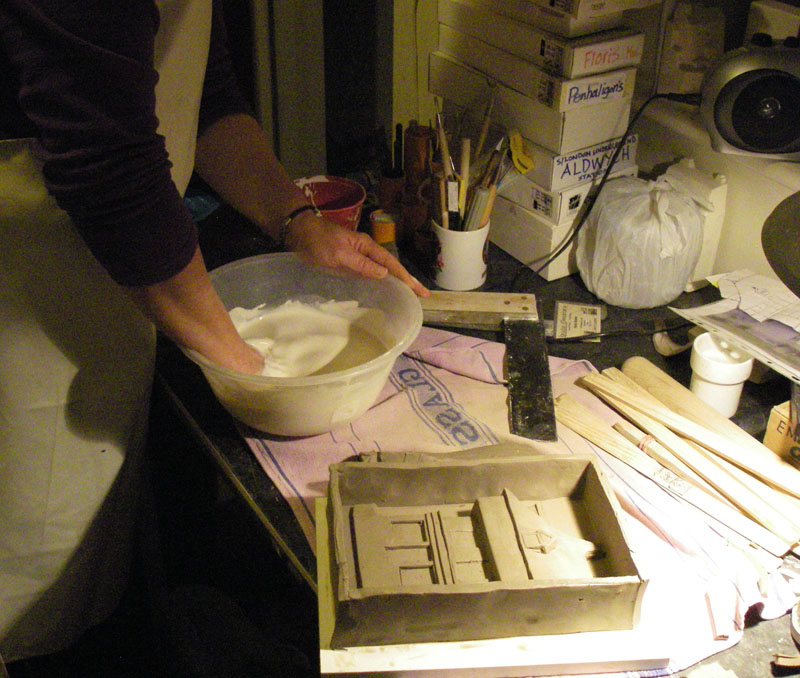
5.
Mix the plaster by placing your hand in the
bottom of the container but try not to introduce additional air into the
container.
6.
Slowly pour the plaster into the box you created
earlier.
7.
Wait at least 24 hours before using your mold.
It’s really that simple. And it takes practice since the
first time I did it, I didn’t use enough plaster and it spilled through my
sealed joints and all over the counter.
Subscribe to:
Posts (Atom)