Sunday, March 31, 2013

NCAA basketball pools


As I write this we are in the midst of March Madness –potentially my favorite March holiday. And if you are anything like me, you probably filled out a bracket and probably threw down a little bit of cash to makes things interesting. What you probably didn’t know is that each states has various rules and regulations for sports betting and in certain jurisdictions, you can even legally gamble!

Since I write this from Iowa, I thought I would take the time to share with you what some of the highlights to Iowa’s laws are for March Madness pools.

1.      In a beer and liquor establishment gambling by way of filling in NCAA Basketball Tournament brackets is not allowed.
a.       Sports Betting Pools are allowed for individual games of the tournament, but must follow the Sports Betting Pool guidelines.
b.      Winnings from the pool cannot exceed $500.
2.      All other locations including offices and other businesses —in all locations other than Beer & Liquor Establishments gambling on NCAA Basketball Tournament brackets is allowed as long as all rules and regulations are adhered to.
a.       No participant wins or loses more than a total of $50 in one or more games at any time during any period of 24 consecutive hours.
b.      All ages can participate.


Wednesday, March 27, 2013

U.S. coins and ridges

Every time I reach into my piggy bank and grab a handful of coins I seem to notice that many of them contain ridges. I hadn't really thought much about it until recently when I decided to figure out the meaning of the tiny groves. Upon doing some research I discovered a page on the U.S. Mint's website dedicated to my exact question.

Basically, the "reeded edges" as the mint puts it, were originally put in place to "deter counterfeiting and the fraudulent use of the coins, such as filing down the edges in an attempt to recover the precious metals." However, despite the Mint's stoppage of using precious metals in our coins they have continued the use of reeded edges for the visually impaired. As the Mint puts it: "...the ten-cent and one-cent coins are similar in size; the reeding of the ten-cent coin makes it easily identifiable by touch."

This makes me wonder what kind of other tricks and quirks some of our most common items have in place that most of us just aren't aware of.

Tuesday, March 26, 2013

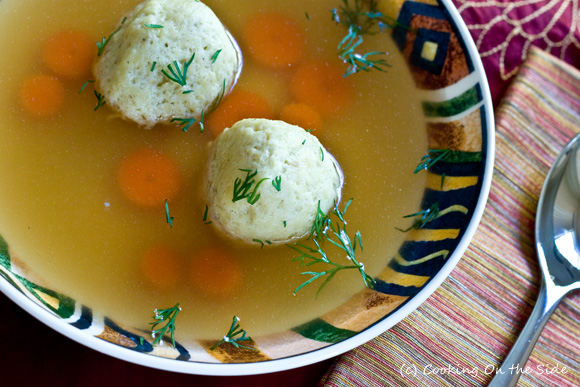
Matzo ball soup


This week marked the start of one of my family’s favorite Jewish holidays –Passover. For those of you who aren’t familiar with the holiday it celebrates the Israelites exodus out of Egypt and their subsequent wandering of the desert. The name “Passover” is in relation to the tenth and final plague commanded by God in which he instructed the Israelites to mark the doorposts of their homes with the blood of a lamb. Upon seeing this, the spirit of the Lord knew to pass over the first-born in these homes, hence the name of the holiday.

One of the most important aspects of the holiday is the traditional seder in which family and friends gather to feast and commemorate the exodus. And one of my most favorite parts of the meal is the traditional soup made with matzo (or unleavened bread) –matzo ball soup. 


I thought this would be a great opportunity to include a recipe on how to make this delicious soup which is good to eat year round –and if you’ve ever been to a deli you may have had it for yourself.

The basic recipe is simple and is as follows:

Ingredients:
2 (10 ounce) packages matzo crackers
1/2 cup butter
6 eggs
salt and pepper to taste
3 tablespoons minced fresh parsley
2 onions, minced
5 ounces matzo meal
96 ounces chicken broth

Directions:
1.
Bring a large pot of lightly salted water to a boil.
2.
Break matzo crackers into small pieces, and place in a large bowl. Add water to cover; allow to soak for a few minutes, until soft. Drain off excess water.
3.
Melt butter in a large skillet over medium heat and stir in drained matzos; stir until mixture is dry and slightly brown. Remove from heat, and mix in eggs, salt and pepper to taste, parsley, and onions.
4.
Mix in just enough matzo meal to make mixture hold together. Roll one golf ball-size matzo ball. Place matzo ball in the boiling water to test the mixture. The ball must rise to the top of the water and not break apart. If it does not rise, then too much matzo meal was added. In this case, add another beaten egg to the mixture and try again. When desired consistency is reached, roll all of mixture into golf ball size spheres.
5.
In a large saucepan, bring chicken broth to a slow boil over medium heat; add balls to broth. Serve soup as the balls rise to the top of the broth.

If cooked well, this is one of the most comforting foods you will ever eat in your life. Try it and you’ll fall in love.

Saturday, March 23, 2013

Plaster molds


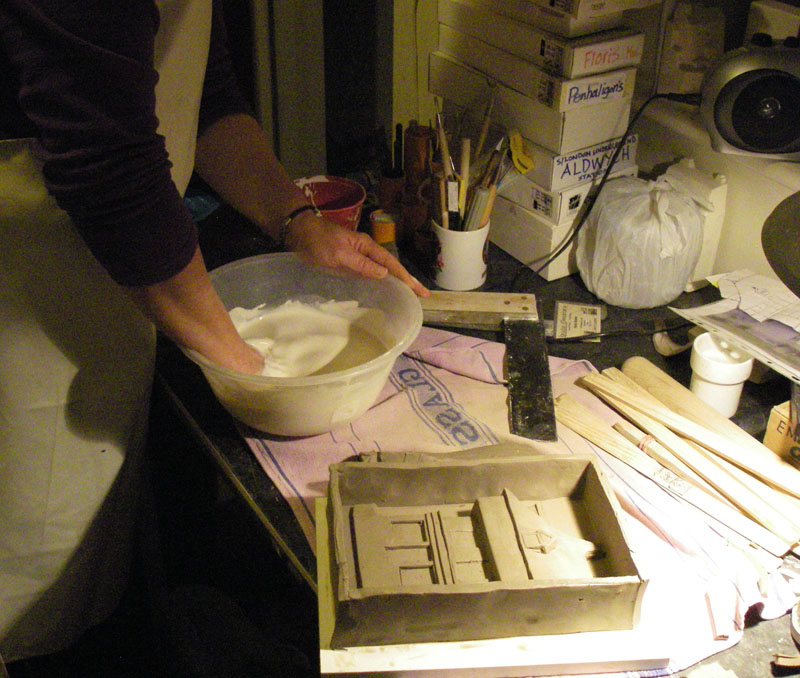
As I’ve probably made clear, I enjoy working with ceramics. One aspect that I enjoy so much is using plaster mold as a means to produce pieces rapidly and identical to one another. Prior to this semester I had used these molds but never made them –which brings me to today’s thing.

Plaster molds can have other uses besides ceramics but I’m going to let you figure out what that is. Regardless, the process is really simple and goes as follows.

1.      Set up your coddles (wooden boards used to hold the plaster in place) and clamps around the object you plan on making a mold of.
2.      Seal the joints of the coddle with clay.
3.      Fill a separate container approximately 1/3 with cold water.
4.      Sift handfuls of plaster powder into the cold water slowly until the plaster isn’t absorbed anymore.
5.      Mix the plaster by placing your hand in the bottom of the container but try not to introduce additional air into the container. 
6.      Slowly pour the plaster into the box you created earlier.
7.      Wait at least 24 hours before using your mold.

It’s really that simple. And it takes practice since the first time I did it, I didn’t use enough plaster and it spilled through my sealed joints and all over the counter.


Tuesday, March 19, 2013

Building a wood-fired kiln


Over this past weekend I was fortunate enough to take part of a wood kiln firing at the ceramics studio in Dows Fine Arts Center. I decided to take part in the firing because I myself included a piece (see below). This was a great experience and really got me thinking as to how I could build a wood fired kiln at my house someday. And to my surprise, it is rather simple since after all, this is how the early forms of ceramics were fired. 

 Coe's wood kiln

More detailed instructions can be found here. But I can best describe the construction of a wood fired kiln as being a rectangular structure with a chimney built entirely out of bricks.

It is really rewarding to take part in one of these firings because you see the transforamtion of your pottery within a matter of hours. I would highly recomend taking part in such a process if one is ever lucky enough (or interested enough) to do so. 

  
Mine is the teapot in the middle


If you want to see more photos of the process and of the ceramics we fired, visit Justina Cline's blog here

Sunday, March 17, 2013

At-home genetic testing

Recently I stumbled across an article on the Huffington Post about a genetics class at the University of Iowa. What was so noteworthy about this class is that instead of having a final exam, the professor gave students the option to get their DNA analyzed for over 240 different possible conditions, abnormalities, etc. I was instantly intrigued so I decided to look up the service more closely.

Upon my research I discovered the company that does the DNA analysis -23andme. Originally the service was $300 but due to recent investments they were able to reduce the price to a mere $100. How it works is quite simple: spit in a tube and mail it to their headquarters in California. Besides testing for your health, the company also markets their services as a means to learn about your family history and connect to people whose DNA matches yours most closely.

I have been absolutly facinated by this and I plan to order a kit for my birthday in the coming weeks. But for more information about 23andme and what they can do for you and our society check them out at https://www.23andme.com/

Friday, March 15, 2013

Civilian Drones

If you are like me, you probably have a slight interest in the whole drone industry which our society is becoming accustomed too. If you are not sure what I'm talking about read any number of articles about unmanned aircraft attacks in the Middle East. Regardless, there is a new push in the drone industry to try and market these spy planes for civilian use. An article on the Huffington Post discusses the lobby in charge of trying to rebrand the planes, so to speak.

Personally, I have mixed feelings. On the one hand, these things could pose a great resource in commercial use such as delivering packages for UPS or FedEx to remote places for example. But on the other hand, this is really creepy. We already know of the spy capabilities that these things posses so who is to say that they won't be used on US citizens -if they aren't already. Only time will tell.


Thursday, March 14, 2013

Peanut-free satay sauce


So I consider myself a food lover –I’ll try nearly anything- with the exception of anything containing peanuts. See, I am allergic to those damn legumes and for the most part I haven’t really minded too much. However, one aspect to my allergy that drives me nuts is the fact that I need to avoid Thai food which many people claim is the best ethnic cuisine around.

One way around this which I discovered over spring break was that I could substitute anything that had peanuts in it for other nuts. Eureka! I now share with you, a recipe for a satay sauce that I made which my friends absolutely adored and which brought me to the discovery of one of my new favorite foods.

This recipe is originally courtesy of Darlene Schmidt, About.com Guide. I have made tweaks which make the recipe peanut-free. Enjoy!

  • 1 cup fresh-tasting dry roasted unsalted mixture of walnuts,  macadamias, and almonds
  • 1/3 cup water
  • 2 cloves fresh garlic, minced
  • 1/2 tsp. dark soy sauce
  • 2 tsp. sesame oil
  • 2 Tbsp. brown sugar
  • 2 Tbsp. fish sauce, depending on desired saltiness/flavor - Vegetarians substitute 1.5 -2.5 Tbsp. regular soy sauce
  • 1/2 Tbsp. lime juice
  • 1 tsp. Thai chili sauce (more or less to taste)
  • 1/3 cup coconut milk
  • Optional: 1-2 whole chilies (I used a Serrano and a jalapeno)
Simply add the nuts to a food processor or blender and pulverize to a fine powder then add the rest of the ingredients. Taste test. Add more fish sauce (or soy sauce) if not salty enough, or more cayenne if not spicy enough. If too salty, add a squeeze of fresh lime juice. If you'd prefer it sweeter, add a little more sugar.

It’s that simple. Add to fresh grilled meat, veggies, or tofu or use it as a dipping sauce. It’s incredibly delicious and I was thrilled to be able to add this to my go-to list of sauces to make.